15 Social Proof Examples to Boost Website Trust
I was reviewing some recent market sentiment reports, and one statistic always stands out: 87% of businesses truly believe consumers place high trust in their brand. But the reality is stark—only 30% of consumers agree. This is a massive perception gap.
This trust gap makes modern shoppers incredibly cautious. With endless options just a click away, people default to what others are doing.
Social proof is a psychological principle where the actions and behaviors of others influence your decisions, helping you feel confident in your choices. It's a safety net for anyone overwhelmed by digital noise and too many choices.
Our goal here is simple: to show you 15 concrete social proof examples ready for your website in 2026. These tactics bridge that trust gap, calm customer anxieties, and drive more conversions directly to your bottom line.
What is social proof?
Social proof is a psychological principle, introduced by Robert Cialdini in his 1984 book, Influence: Science and Practice, where people look to the actions of others to decide on correct behavior, especially when uncertain. In 2026, it's more than just star ratings.
It's a marketing tactic that leverages the experiences and endorsements of others to reassure potential customers they're making a solid choice. And it's become table stakes for winning customer trust.
The concept of social proof was popularized in the field of psychology; you can find more background on the subject here.
Modern shoppers have options overload, and social proof cuts through the noise. It builds confidence where skepticism runs rampant.
Trust signals, both visual and textual, are designed to build this confidence. But they have to be authentic. Because while 83% of Americans say recommendations from friends and family sway their purchase decisions, a massive disconnect exists. Businesses overestimate consumer trust.
The truth is that 87% of businesses believe consumers trust them, yet only 30% of consumers actually do.
Why people follow the crowd
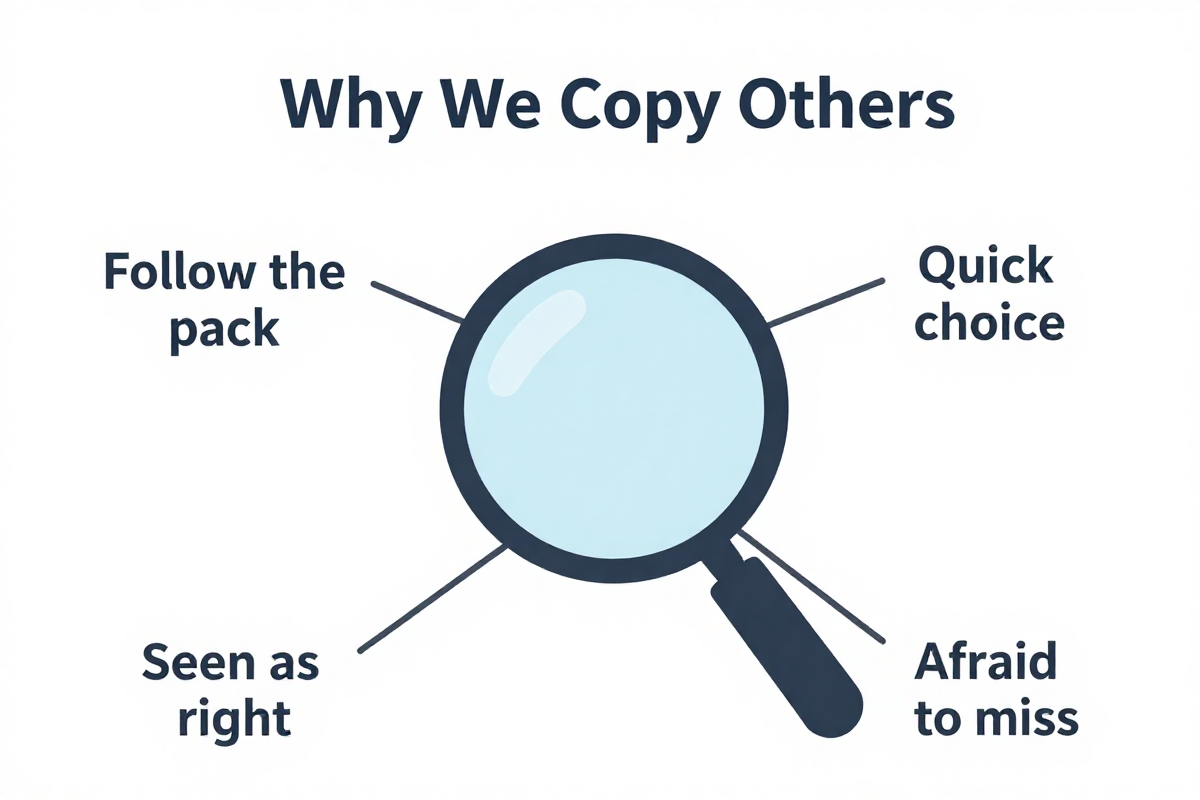
People follow the crowd because of deeply ingrained cognitive biases that act as mental shortcuts. Our brains are wired to look for patterns and take the path of least resistance when making decisions.
Two major biases drive this behavior: the Bandwagon Effect and Informational Social Influence. (And no, they are not the same thing.)
The Bandwagon Effect: "Everyone's Doing It!"
The Bandwagon Effect is that urge to do something simply because others are doing it. Think of it as social peer pressure. This bias often stems from a desire to fit in, avoid missing out (FOMO), or believe that popular choices must be good ones.
It’s a powerful force, particularly in marketing. If a product is trending, consumers may jump on board without fully evaluating their own needs or the product's suitability.
Informational Social Influence: "They Must Know Something I Don't!"
Informational Social Influence comes into play when we assume that others possess more knowledge than we do. This is especially true in unfamiliar or ambiguous situations. If we see a group of people choosing a particular product or service, we might assume they have inside information or have done their research, leading us to follow their lead.
Think about reading online reviews. If hundreds of users rave about a restaurant, you're more likely to trust their collective experience than to rely solely on your own initial judgment.
Avoiding Buyer's Remorse: Social Proof as a Safety Net
Our brains use social proof as a shortcut to minimize the risk of buyer's remorse. With countless options available, the fear of making the wrong choice is real. By observing what others are doing, we attempt to reduce uncertainty and feel more confident in our decisions.
It's a simple equation: If others are happy with a purchase, chances are, you will be too. This is why showcasing positive testimonials and reviews is so effective. Read more about how to boost website conversions with customer testimonials.
So, next time you find yourself following the crowd, ask yourself if you're truly making an informed decision or simply succumbing to these powerful biases. Understanding these influences can help you make more conscious choices, and help you better utilize social proof in your marketing efforts.
Now, here is a next step: start collecting social proof elements and incorporate them strategically into your website to build trust and drive conversions!
 Why people follow the crowd
Proven social proof examples to try in 2026
Social proof isn't about bombarding your site with endless badges. It's about strategically placing high-quality indicators at key decision-making moments. Here are 15 examples to test.
Proven social proof examples to try in 2026
These examples are categorized by the specific psychological influence they exert on a user. The goal? Authenticity and quality always beat raw volume.
Social Proof Examples Based on Popularity
Harness the power of numbers to show what's trending.
- "Best Seller" Badges: Highlight your top-selling products to draw attention and signal popularity. People tend to trust popular choices.
- "Most Popular" Lists: Curate lists showcasing products or services favored by most customers. These act as a guide for new users.
- Trending Now Sections: Feature real-time trends on your site, displaying what's currently in demand. It's a great way to capitalize on current buying behavior.
Social Proof Examples Based on Expert Opinion
Third-party endorsements carry serious weight.
- Expert Reviews: Showcase reviews from industry experts or influencers. This adds credibility, especially when experts have a proven track record. (But make sure they're real experts.)
- Certifications and Awards: Display any relevant certifications, awards, or accreditations your business has earned. The visual cues are a signal to customers that your business or service is a cut above.
- Partnerships with Reputable Brands: Feature logos of well-known brands you've partnered with. Just be sure the partnership is clear and legitimate, or the whole thing falls apart.
Social Proof Examples Based on User Experience
Real stories from real customers are gold.
- Customer Testimonials: Use direct quotes from satisfied customers, highlighting their positive experiences. Want some tips? Then learn how to boost website conversions with customer testimonials.
- Case Studies: Share in-depth stories detailing how your product or service has helped customers achieve specific goals. Include measurable results for maximum impact.
- Reviews and Ratings: Prominently display customer ratings and reviews on product pages. Encourage customers to leave honest feedback (the good and the bad).
Social Proof Examples Based on Community
Showcase the size and engagement of your community.
- Social Media Follower Counts: Display your follower counts on social media platforms. A large following suggests a strong community and brand affinity.
- User-Generated Content: Feature content created by your customers, such as photos, videos, or blog posts. This shows that people actively engage with your brand.
- Forum or Community Activity: If you have a forum or online community, highlight its activity levels, such as the number of members or daily posts. And if you're thinking of adding customer videos, then you can learn more about driving growth with them.
Social Proof Examples Based on Trust Signals
Reassure visitors about security and reliability.
- Security Badges: Display security badges from trusted providers like Norton or McAfee to reassure visitors that your site is secure. But make sure you actually have a valid certificate.
- Privacy Policies: Clearly communicate your privacy policies and data protection practices. Transparency builds trust, especially in today's privacy-conscious world.
- Guarantees and Warranties: Offer money-back guarantees or warranties to reduce perceived risk. Remove the hesitation to buy.
Next, identify the most relevant types of social proof for your audience and start incorporating them strategically into your website. Begin testing which ones resonate best with your audience and watch those conversion rates improve!
Direct customer feedback examples
Direct customer feedback builds trust because it's unfiltered validation from peers, not marketing hype. It offers a genuine glimpse into the user experience, which can significantly influence potential customers.
But the trick is using it correctly. Slapping up any old review won’t cut it.
The Power of Unfiltered Voices
Customer reviews are powerful sales tools. They showcase real-world experiences with your product or service. People trust these unfiltered voices more than polished marketing copy (83% of Americans say they decide to purchase a product or service based on recommendations from friends and family.).
Testimonials, on the other hand, are curated, so they’re often viewed with a bit more skepticism.
Making the Most of Customer Reviews
- Display prominently: Put reviews where people will see them—product pages, checkout, even your homepage.
- Variety is key: Mix up short snippets with longer, more detailed accounts.
- Show the stars: Star ratings provide a quick visual summary of overall satisfaction.
- Don't hide the negative: Address negative reviews openly. It shows you're listening and willing to improve.
Displaying customer feedback isn't just about showing off positive experiences; it's about building a transparent relationship with your audience. People want to know the good, the bad, and the ugly before they commit.
Testimonials That Pack a Punch
A strong testimonial speaks directly to a pain point, showcases the solution, and highlights the benefit. The best testimonials are specific, relatable, and come from people your audience can identify with. Here's how to do it right:
- Specificity wins: Avoid vague praise like "Great product!" Instead, look for testimonials that detail specific benefits (e.g., "Increased conversions by 20% in one month").
- Relatability is key: Feature testimonials from customers who resemble your target audience.
- Video testimonials are gold: Seeing and hearing a real person adds an extra layer of authenticity.
We've seen firsthand how powerful authentic customer videos can be; discover more about driving growth with authentic customer videos. This isn't just about adding flair to your website. It’s about creating an emotional connection that text alone can't achieve.
How to Ask For Reviews (Without Being Annoying)
Timing is everything. Don't bombard customers with review requests right after they buy. Give them time to experience your product or service first.
Here are few rules:
- Automate your requests: Use email marketing to send review requests a few days or weeks after purchase.
- Keep it simple: Make it easy for customers to leave a review. Provide direct links to review platforms or a simple form on your website. (By the way, this only applies if you're using WordPress 6.0 or higher.)
- Personalize the message: Address customers by name and thank them for their business.
- Incentivize (ethically): Offer a small discount or bonus for leaving a review. (Just don't bribe them to write something fake.)
Getting customer feedback is a two-way street. You ask for it, you get it, and then you act on it. And if you want more information, here’s a guide on how to ask for reviews without being annoying.
Video testimonials from real users
Video is the gold standard for trust. Forget slick, over-produced ads; raw, authentic video of real customers converts better.
People see right through the polished veneer of traditional advertising. They crave genuine connection, and there's nothing quite like seeing someone like them share their honest experience with your product.
Why video is king
- Human connection: Video allows potential customers to see and hear the emotion in a testimonial.
- Authenticity: Unscripted, unpolished videos feel more genuine and relatable. (Remember that customers often respond better to videos that are created on mobile than ones created by marketing teams.)
- Show, don't tell: Video can demonstrate how your product works and the benefits it provides in a way that text simply can't.
Raw vs. Refined: What converts better?
The irony? Often, the less polished the video, the better it performs.
Why? Because it screams authenticity. The shaky camera, the background noise, the "ums" and "ahs" – it all makes the testimonial feel real. It's clear that the person isn't reading from a script or being coached.
Getting video testimonials right (the Testimly way)
At Testimly, we built our platform to make it easy to collect, manage, and showcase these authentic customer videos. Because here’s the truth: people are busy.
Here’s what works:
- Keep it short: Aim for testimonials that are under 60 seconds.
- Focus on specific benefits: Ask customers to highlight the most impactful results they've achieved using your product.
- Showcase personality: Encourage customers to be themselves and share their unique perspectives.
Don’t be afraid of imperfections. In fact, embrace them. That's where the magic happens.
Now, make sure you have processes in place that capture, store, and share video proofs.
Text reviews with verified purchase badges
Text reviews alone are good. But text reviews with a "Verified Purchase" badge? Even better.
The "Verified Purchase" tag adds a layer of trust by confirming that the reviewer actually bought and (presumably) used the product. This helps fight fake reviews and gives potential buyers confidence that the feedback is legitimate.
The Impact of Verified Reviews
Verified reviews are powerful trust signals. They show that the feedback comes from real customers, reducing the perception of bias or manipulation. Think of it as an anti-BS measure.
- Boost Credibility: Prove reviewers aren't bots or paid shills.
- Increase Confidence: Make potential buyers feel safer about their purchase.
- Drive Conversions: Turn hesitant visitors into paying customers.
But how do you get verified reviews?
Implementing Verified Review Systems
Most e-commerce platforms offer built-in features for verifying purchases, or you can use third-party review services. The key is to ensure that the verification process is transparent and reliable.
Here's how it typically works:
- Order Tracking: The system tracks which customers have actually made a purchase.
- Review Request: After a set period, customers receive an email asking them to review their purchase.
- Verification: The system checks if the reviewer is a verified buyer before publishing the review with the "Verified Purchase" badge.
Just remember to monitor those reviews and respond to any negative feedback promptly. Ignoring problems can erode trust faster than a bad review itself.
Case studies highlighting specific results
Case studies are the "show, don't tell" of the B2B world. They offer concrete proof that your product or service delivers real results.
It's the difference between saying you can increase efficiency and demonstrating a 40% reduction in operational costs for a client within six months.
"Before vs. After" is the Only Story That Matters
Focus on the transformation. The most compelling case studies vividly illustrate the "before" state – the pain points, the inefficiencies, the missed opportunities – and then contrast it with the "after" state, showcasing the tangible improvements achieved with your solution.
Consider this example from a SaaS provider specializing in marketing automation:
Before using the SaaS provider's platform, a B2B company struggled with lead generation, converting only 2% of website visitors into qualified leads each month. Sales cycles were long, and marketing efforts felt scattered.
After implementing the platform, the company saw a dramatic shift. Within three months, their lead conversion rate jumped to 12%, sales cycles shortened by 25%, and marketing ROI increased by 150%. This wasn't just about features; it was about tangible, measurable improvements that directly impacted the bottom line.
Make it Specific, Make it Believable
Generalities kill case studies. Use specific numbers, metrics, and examples to make your claims credible. Avoid vague statements like "improved efficiency" or "increased sales." Instead, quantify the results with concrete data points.
- Use client names: Don't hide behind anonymity unless absolutely necessary. Real names build trust.
- Show the numbers: Include specific ROI metrics, such as cost savings, revenue increases, or time reductions.
- Tell a story: Frame the case study as a narrative, highlighting the challenges, the solutions, and the outcomes.
The key is authenticity. Showcase real customer success stories, not fabricated marketing fluff.
And because the proof is in the pudding, our team likes to capture video testimonials from our clients. We've seen firsthand how powerful authentic customer videos can be; discover more about driving growth with authentic customer videos.
Next step? Start documenting those success stories and let your customers do the talking.
Third party validation examples
Third-party validation is when an outside entity vouches for your brand, signaling trustworthiness and expertise. These authority signals, like expert endorsements, carry significant weight, particularly with skeptical customers.
But relying solely on internal marketing can feel like shouting into the void. People want unbiased opinions.
Types of Third-Party Validation
- Expert Reviews: These reviews come from recognized authorities in your industry. Their endorsements are like gold stars.
- Industry Awards: Winning awards demonstrates your company's excellence and innovation in a tangible way.
- Accreditations: These show you've met specific industry standards, which builds trust, especially in regulated sectors.
This works because consumers often trust expert opinions more than a company's own claims (83% of consumers trust recommendations from people they know).
Getting the Endorsement
The biggest hurdle? Getting on their radar in the first place. Start by building relationships with key influencers in your niche. But don't just blindly ask for reviews. Offer value first.
- Provide exclusive access: Give experts early access to your product or service.
- Offer insightful data: Share proprietary research or data that’s relevant to their audience.
- Engage authentically: Participate in their discussions, comment on their content, and show genuine interest in their work.
How to Properly Showcase Endorsements
Once you've got that validation, show it off. But do it right. Don't just slap a logo on your homepage and call it a day. Provide context. Explain why the endorsement matters and what it means for your customers.
For example, include a quote from the expert review that highlights a key benefit of your product. This adds credibility and helps potential customers understand the value you offer. Also, feature industry awards prominently on your website, and explain the criteria you met to win them.
And if you've achieved any relevant certifications, display the corresponding badges with pride.
By strategically incorporating these third-party endorsements into your marketing efforts, you can build trust, establish credibility, and ultimately, drive more conversions. This also includes showing real stories from real customers that are worth its weight.
Examples of Third-Party Validation in Action
- Software Company: A software company features a review from a leading tech blogger, highlighting its user-friendly interface and powerful features.
- Financial Institution: A financial institution displays its accreditation from a respected industry association, demonstrating its commitment to ethical business practices.
- E-commerce Business: An e-commerce business showcases a "Best of" award from a popular consumer magazine, signaling its quality and value.
Building Trust with Testimly
Our team built Testimly to assist with showcasing validation, especially through video. We make it easy to gather and present authentic video testimonials from your customers, turning their experiences into powerful social proof.
Next, start focusing on collecting authentic customer success stories and let your customers do the talking!
Industry awards and certifications
Industry-specific badges serve as a shortcut for trust. They're a pre-vetted stamp of approval.
Think of it like this: awards and certifications are an outside signal that you're not just making claims; someone else is backing you up. In fact, 83% of consumers trust recommendations from people they know.
Here’s why they matter:
- Instant credibility: Badges like "G2 Leader" or ISO certifications tell potential customers you meet specific standards.
- Reduced risk: Certifications act as a safety net. If an industry body says you’re legit, customers feel safer.
- Competitive edge: In crowded markets, awards set you apart. (Assuming they're real awards, of course. No participation trophies.)
Now, how do you get these trust badges? The truth is that you need to build your business around getting industry validation.
Showcasing them is the easy part. Getting them? That's the grind.
And because our team likes to display results, we always try to capture video testimonials from clients. We've seen firsthand how powerful authentic customer videos can be; discover more about driving growth with authentic customer videos.
Media logos and press mentions
An "As Seen On" bar can transfer credibility. Seeing recognizable media logos on your site acts as a shortcut for trust, borrowing authority from established news outlets.
Think of it as a visual endorsement. Potential customers instantly associate your brand with the reputation of those media outlets. It's a quick way to signal legitimacy and trustworthiness.
But the key is relevance. Don't just display any logos; showcase media outlets that are relevant to your industry or target audience.
- Industry-Specific Media: Feature logos from publications that cater to your niche.
- Tier One Recognition: Prioritize major news outlets or well-respected industry publications.
- Verification is Key: Ensure your mentions are legitimate and verifiable.
The bigger issue? Getting those media mentions in the first place. The key thing here is you need to build relations and get your story and brand known!
The media outlets that you are mentioned on reflect the quality of your service/product or company, you need to strive to get on bigger and better platforms to grow your brand.
The better your brand is known the better the conversion rates on your site.
Now, start building relationships and start getting media mentions.
Influencer and expert endorsements
Influencer endorsements aren't created equal. There's a chasm between a celebrity shout-out and a niche expert's technical approval.
For SaaS, blockchain, or any high-consideration purchase, a genuine expert endorsement can be pure gold. Forget the fleeting buzz of a celebrity post.
- A deep dive into the product's functionality is what matters.
Why Niche Experts Trump Celebrities
Celebrity endorsements are often perceived as paid promotions. They can drive initial awareness, but seldom convert skeptical prospects, because you often have an audience that isn't related to your product in any way. Experts, on the other hand, bring credibility.
Their validation stems from deep understanding, not just a fat paycheck. And for a SaaS product requiring buy-in from the IT team or C-suite? That expert's word is a deal-maker.
The Power of "Technical Social Proof"
"Technical social proof" is when an expert validates the underlying tech, security, or methodology of your product. It's not just "it works," but why it works, that builds trust.
For example, a security expert endorsing a password manager's encryption protocol or a data scientist validating an AI model's accuracy. This gives the end-user confidence to know they are getting a service/product from a reputable source.
Landing Expert Approvals
- Target niche publications: Don't pitch Forbes if you're a developer tool. Aim for specialized blogs with engaged, technical audiences.
- Offer exclusive data: Provide experts with proprietary insights or research they can use in their content.
- Focus on benefits to their audience: Explain how your product solves a specific problem for their followers.
The bigger issue? Just make sure you're building authentic realtionships with the influencers.
Wisdom of the crowd metrics
Wisdom of the crowd metrics showcase the power of numbers. When a large group of people are using something, it often signals trustworthiness and value.
Quantifying your user base provides immediate social proof. But it’s not just about vanity metrics; it’s about showcasing active engagement and widespread adoption.
- Total Users: Display the total number of users on your platform. It's a simple way to showcase popularity.
- Active Users: Highlight the number of daily or monthly active users (DAU/MAU). This shows the platform is being used consistently.
- Growth Rate: Share your user growth rate over time. High growth indicates increasing popularity and value.
But you can't just pluck these numbers out of thin air; be transparent about the source and timeframe of your data. (Otherwise, you risk alienating potential customers).
For instance, we like to show how many video testimonials have been collected and shared through our platform. Because, here at Testimly, we are passionate about showcasing genuine customer experiences, offering a streamlined tool for capturing, managing, and sharing these authentic customer videos.
Active user counts and total subscribers
Active user counts speak volumes about platform reliability. "Join 50,000+ marketers" isn't just a number; it's a safety net.
It's simple math: a large customer base reduces the perceived risk of trying a new product. But why?
Because you assume that a crowd of users have already vetted the product. That the major bugs are gone. That the company isn't going to disappear overnight.
Subscriber count paints a picture of engagement. It suggests people are actively interested in your content, updates, and overall brand. It's also a good indicator that the company will be around for the long haul.
And that's the trust no-one talks about. Will your vendor be around next year? Or will they shutter the doors and leave you stranded? The bigger the community, the more likely they'll survive.
Next, make sure you analyze other companies to know their numbers and see how you match up.
Real time activity popups
Real-time activity popups are live notifications that tell website visitors what others are doing on the site. Think: "Someone in London just bought X!"
But while the data shows that these notifications can induce FOMO (fear of missing out), overuse can quickly backfire. Annoyance sets in when they're too frequent, too intrusive, or simply irrelevant to the user.
The Double-Edged Sword of Live Notifications
FOMO notifications work on a simple principle: people are more likely to take action if they see others doing the same.
These notifications can boost conversions by creating a sense of urgency and social proof. The catch? The effect wears off if users feel like they're being bombarded with constant sales pitches.
Here’s why frequency matters:
- Too many: Overwhelms visitors, leading to banner blindness or outright irritation.
- Too intrusive: Disrupts the user experience, pushing people away.
- Irrelevant: Shows activities unrelated to the user's interests, decreasing engagement.
The key is striking a balance between creating urgency and avoiding annoyance.
Striking the Right Balance
Monitor the frequency and impact of your notifications by using A/B testing. Set notification frequency to 1 every 30 seconds. This lets you see how they affect conversions and user behavior.
Consider these additional strategies:
- Targeting: Show notifications based on user behavior and interests. If someone is browsing a specific product category, show notifications related to that category.
- Timing: Display notifications at strategic moments in the user journey, such as when someone lands on a product page or adds an item to their cart.
- Relevance: Highlight actions that are relevant to the user's interests and needs.
The bigger issue? Don't over-hype your product. Just like the boy who cried wolf, too many false alarms and people will stop believing you.
Social media follower growth
Social media follower growth transforms your social channels into a 24/7 validation engine. A large, engaged following acts as a constant stream of social proof, reassuring potential customers that your brand is worth paying attention to, even when they're not actively on your website.
Consider these key metrics to build your validation engine:
- Follower Count: A high follower count shows popularity and establishes credibility.
- Engagement Rate: Consistent likes, comments, and shares suggest an active and interested community.
- Content Reach: Broad content reach means your message resonates and reaches a wider audience.
But here's the catch: buying followers is a short-sighted strategy that destroys trust. Fake followers don't engage, and people can spot them a mile away. It's like wearing a fake Rolex – it might fool some people for a minute, but the cracks eventually show.
The bigger issue? It's harder than ever to create authentic social signals, so you need to focus on creating genuine relationships.
Visual and interactive trust signals
Visual and interactive trust signals capture attention faster than static text. People are naturally drawn to movement and visuals, making these signals highly effective for instantly conveying credibility.
But they have to be done right. Think beyond basic star ratings.
User-Generated Content (UGC): Real People, Real Results
UGC, like customer photos and videos, is incredibly powerful because it feels authentic. It's not a staged ad; it's a genuine customer experience shared in their own words (or visuals).
- Instagram Takeovers: Let a customer run your Instagram account for a day.
- Customer Photo Galleries: Showcase customers using your product in real-life scenarios.
- Video Testimonial Compilations: String together short video testimonials into a compelling montage.
Here at Testimly, our team is focused on streamlining the collection and showcasing of authentic customer videos. We know that video testimonials from real users builds brand trust and creates connection!
Rich Snippets: Stand Out in Search Results
Rich snippets use schema markup (structured data) to display extra information in search results. Think star ratings, product availability, and pricing info directly under the search result.
This makes your listing far more eye-catching and informative, increasing click-through rates by as much as 30%. It's a subtle but effective way to build trust before someone even clicks on your website.
Interactive Content: Engage and Inform
Interactive content, such as quizzes, polls, and calculators, can subtly showcase your expertise and build trust by providing value upfront.
A financial planning firm might offer a retirement calculator. A SaaS company may provide an ROI calculator for its product. The information is helpful, shows you know your stuff, and keeps the user engaged longer (positive signal to Google).
The limitation is that this requires more development resources and a deep understanding of your customer's needs.
Next step: identify where these visual signals can make the biggest impact on your website and start experimenting!
Raw user generated content unboxings
Raw unboxings on TikTok or Instagram Reels feel more real. They're shot on phones, often shaky, and rarely edited beyond basic cuts. That's why they work.
Polished brand photography, while visually appealing, can sometimes feel too slick. Consumers are savvier now; they recognize staged content immediately and often view it with skepticism.
- Raw, unedited content feels more authentic.
- It builds trust.
- It shortens the distance between brand and customer.
The bigger issue? Brands often try too hard to "create" authentic UGC, which defeats the purpose. Instead, focus on encouraging customers to share their genuine experiences.
According to this 2026 study, user-generated content has become a primary driver of purchasing decisions, eclipsing even brand-created content in some categories. The difference is subtle but critical. It's the implicit trust that comes from seeing someone like you rave about a product, not a perfectly posed model in an ad.
Best seller badges on product pages
"Best Seller" badges simplify choice overload by highlighting trending items. Think of it as the "Amazon effect" creeping into every corner of e-commerce.
Users now instinctively hunt for the "Best Seller" or "Amazon's Choice" tag, looking for validation.
It's a mental shortcut. Instead of comparing 17 different blenders, they go straight for the one with the badge, assuming it's a safe bet.
- Add these tags to your own e-commerce product pages and watch the conversion rates climb.
The real trick is in managing the tags themselves. Because a "best-seller" in January might be a shelf-warmer by June. Keep those badges updated to reflect current sales data.
Integration logos for software tools
For SaaS, integration logos are more than window dressing; they're a seal of approval. Showing that your tool plays nice with the big boys (Slack, Google, Salesforce) instantly boosts credibility.
It's partnership proof. Think of it like this:
- If your software integrates with Salesforce, you're signaling enterprise-grade trustworthiness.
- Google Workspace integrations show you're serious about productivity.
- Slack means you understand the importance of team collaboration.
But slapping up a logo isn't enough. You need to show how these integrations work and the benefits they provide. Offer deep, native integrations instead of just basic API connections. Make it dead simple for users to connect their accounts and start using the integrated features immediately. After all, what use is mentioning these logos if the end user doesn't know what they are and how to use them? This is why they matter so much in the end. Because they increase ease of use.
Community forums and public groups
A vibrant community forum or public group tells potential customers that your brand is more than just a product; it’s a living, breathing ecosystem. It signals that others have bought in, found value, and stuck around.
The trick is to make sure it's active and genuine. A ghost-town forum will actively hurt your brand.
From Zero to Community Hero
Start with a clear purpose and a strong hook. What unique value will your community offer? Early access to new features? In-depth tutorials? A direct line to your product team?
- Define your niche: Focus on a specific topic or interest related to your brand.
- Create a welcoming environment: Set clear guidelines for respectful communication.
- Incentivize participation: Reward active members with exclusive content or perks.
Discord vs. Slack vs. Forum: Choosing Your Weapon
Each platform has its strengths and weaknesses. Discord is great for real-time chat and building a playful community. Slack is better for professional networking and collaboration. A traditional forum offers a structured space for long-form discussions (though it can feel a little outdated).
The real issue is maintenance. 57% of online communities fail due to lack of moderation and engagement. Plan to dedicate resources to actively managing your community and fostering meaningful interactions.
And speaking of engagement, at Testimly, we understand the power of authentic connection. Which is why we built our platform to help you showcase real customer voices. We've seen firsthand how powerful authentic customer videos can be; discover more about driving growth with authentic customer videos.
Now, build your community and get ready to make genuine connections.
Search result rich snippets with star ratings
Rich snippets start your social proof journey right on the Google search results page (SERP). It's prime real estate, and if you're not using schema markup to showcase star ratings, you're missing out.
Rich snippets are enhanced search results that display extra information, like star ratings, product availability, and pricing. The goal? Entice clicks with visual validation.
But it's not just about looking pretty; it's about boosting click-through rates (CTR). Listings with star ratings stand out and scream, "I'm trustworthy!".
AI-driven search results take this a step further. Google SGE (Search Generative Experience), for instance, now aggregates ratings from multiple sources to provide a more comprehensive overview. The AI doesn't just show the average; it synthesizes sentiment from various review platforms, factoring in recency and reliability. This gives users a much more nuanced understanding of a product's reputation. The risk is the ratings have to be consistent.
Now, make sure that the social proof you are displaying matches what is being aggregated by the AI, or you will lose people's trust.
How to implement social proof without looking fake
The line between effective social proof and looking like a cheap knock-off is razor thin. Authenticity is the only thing that matters.
Because the second your audience suspects your social proof is fake, you’ve torched your credibility. And in 2026, brand damage is forever.
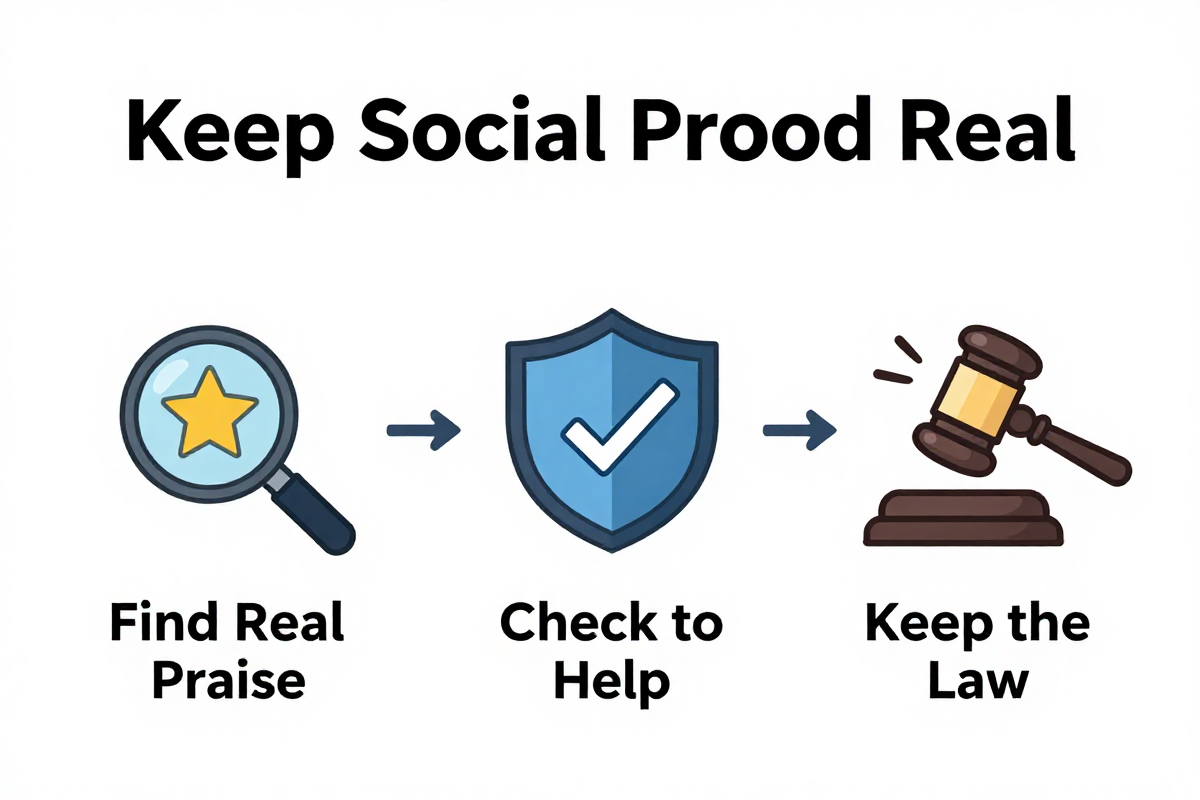
Here’s a checklist to ensure your social proof builds trust, not skepticism:
- Show, don’t tell: Focus on specific results and quantifiable data. ("Increased conversions by 20%" trumps "Great product!").
- Get real people: Use testimonials from actual customers who resemble your target audience. (Stock photos are dead).
- No hiding negative feedback: Address negative reviews transparently. This shows you're listening and willing to improve.
But the biggest threat to authentic marketing is the rise of cheap AI-generated content.
The Dark Side of AI: Fake Reviews and Legal Minefields
Generating fake reviews with AI might seem like a quick win, but it’s a high-stakes gamble that can lead to lawsuits. In 2026, regulators are cracking down on deceptive practices, and the penalties are steep (think fines, injunctions, and even criminal charges).
And you could be sued!
But there's more than just legal risk. AI-generated content is often generic, lacks specific details, and fails to capture the nuances of human experience. Consumers can usually spot it a mile away. (Remember, people crave genuine connection).
AI tools can spin up hundreds of five-star reviews in minutes, but they can't replicate the emotional intelligence of a real customer sharing their experience.
This fails because those AI reviews lack the personal anecdotes and detail that consumers crave. They reek of inauthenticity. (And no one wants that).
The bigger issue? When caught buying or creating fake reviews, expect lasting damage to your brand's reputation, because trust erodes quickly.
Ethical Marketing: The Only Sustainable Path
The alternative? Focus on building genuine relationships with your customers and encouraging them to share their honest feedback. Here are some rules for that:
- Ask for reviews (ethically): Automate review requests after purchase, keep the process simple, and personalize the message.
- Incentivize (slightly): Offer a small discount or bonus for leaving a review (but don't bribe them to write something fake).
- Showcase authentic videos: Capture raw, unedited video testimonials from real customers. Forget the polished ads; authenticity converts better.
Our team built Testimly to make the gathering of authentic customer videos easy. We've seen firsthand how powerful authentic customer videos can be; discover more about driving growth with authentic customer videos.
Stop chasing shortcuts. And instead? Focus on building trust, one honest review at a time.
 How to implement social proof without looking fake
Ways to measure if your social proof is working
Social proof isn't a "set it and forget it" tactic. You need to constantly measure its impact on your bottom line.
The best way to gauge effectiveness? A/B testing.
The A/B Test: Your Social Proof Laboratory
A/B testing lets you isolate the impact of social proof by showing different versions of your website to different user groups. One group sees your social proof elements (testimonials, reviews, badges), while the control group sees the same page without them.
- Track your conversion rates for both groups to see if social proof truly makes a difference. (And no, it’s not hard to track!)
The catch is that you need a decent sample size to achieve statistical significance. Run your A/B tests for at least two weeks to account for fluctuations in traffic and user behavior. Then, dive into the data. Because guessing won’t cut it.
Conversion Rate Lift: The Holy Grail of Measurement
Conversion rate lift is the percentage increase in conversions you achieve by adding social proof to your website. Did adding customer testimonials to your product page increase sales? Did displaying security badges at checkout reduce cart abandonment?
- The conversion rate lift tells you. If the A/B test reveals that the group exposed to social proof saw a 15% increase in conversion rates, you have concrete evidence that your social proof strategy is working.
Be sure to test variations, too. Because while testimonials might work, a video could work even better.
ROI of Testimonial Videos: Attribution is Key
Attribution is a beast, but it's crucial for calculating the ROI of testimonial videos. You need to know where your conversions are coming from. Did someone watch a testimonial video on your landing page and then immediately sign up for a free trial? Or did they watch the video and then come back a week later through a different channel?
Tools like Google Analytics and HubSpot can help you track the user journey and attribute conversions to specific touchpoints.
- Be sure to set up conversion goals and track event data. (Don't just click save; check the log first because you will be sorry later).
Our team built Testimly to help capture, share, and then track the impact of authentic video testimonials. Because seeing where your leads are coming from is critical. It allows you to take control.
Make sure you set your social proof and watch the ROI start coming back.
Getting started with social proof tools
Collecting social proof doesn't have to be a tech nightmare. Founders often drown in spreadsheets trying to wrangle stray emails, DMs, and random acts of praise.
Getting started with social proof tools
The trick is centralizing the chaos. Social proof software helps you automate collection, organization, and display of testimonials, reviews, and user-generated content. Otherwise, you're stuck chasing down screenshots and praying that the Google Doc doesn't get lost in the shuffle.
We built Testimly to solve this directly. Our platform is designed for founders who need to capture and manage authentic customer videos and text testimonials without the headaches (or needing a CS degree). Other approaches often leave you piecing together solutions.
- Manual Collection: You manually gather customer quotes from emails, surveys, and social media mentions. The issue is that you may not know how to ask for reviews.
- Spreadsheet Organization: You log testimonials in a spreadsheet. This is time-consuming and prone to errors. (And good luck keeping it updated.)
- Manual Embedding: You copy and paste each testimonial individually. This is tedious and doesn't scale.
With Testimly, you can automate the entire process, from requesting testimonials to embedding them on your website. One happy user reported it shaved 14 hours a month off their marketing workflow. Stop chasing praise; start showcasing it.
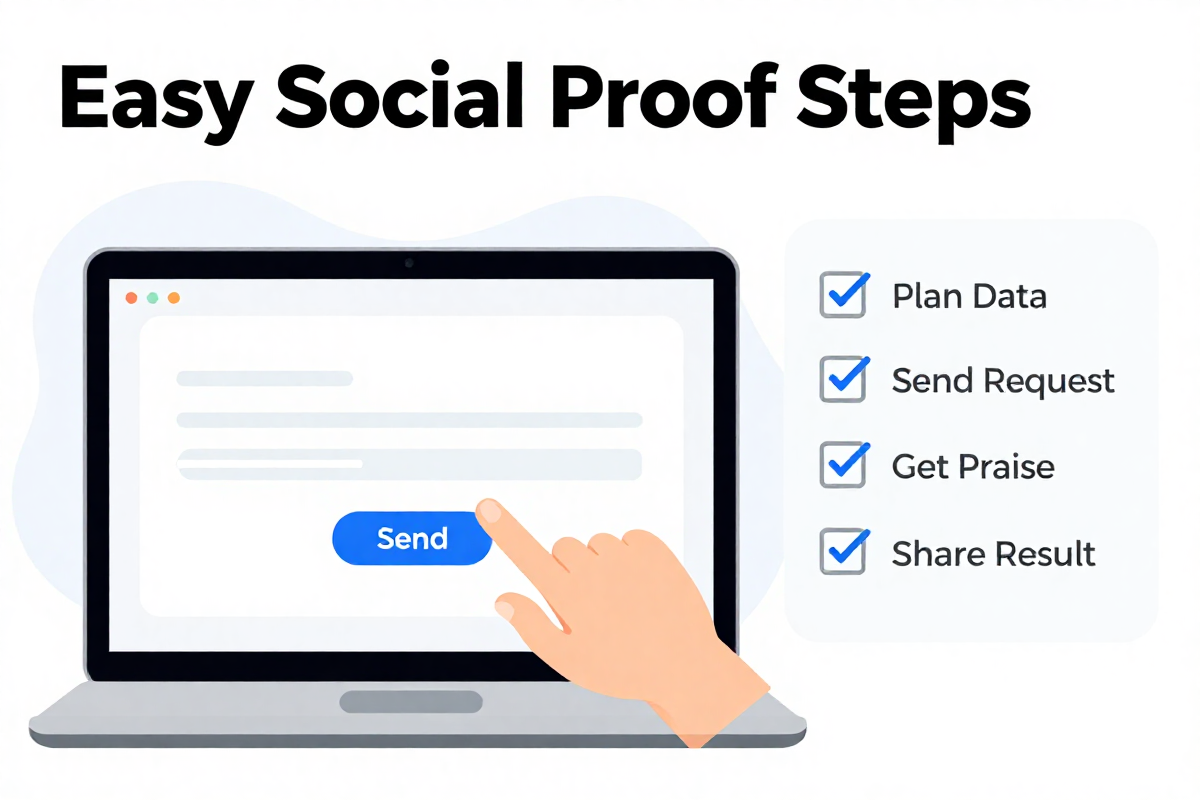 Getting started with social proof tools
Common questions about website social proof
Social proof is crucial, but questions arise. What if you're just starting out? Are negative reviews a must? Let's tackle these common questions.
What if I have no customers yet?
No customers doesn't mean no social proof. The trick is to borrow credibility until you build your own.
- Expert Validation: Seek endorsements from industry influencers or early adopters, even if they aren't paying customers yet. A glowing review from a respected blogger carries serious weight.
- Integration Badges: Showcase logos of tools you integrate with. If your software connects seamlessly with Salesforce or Slack, that alone signals trustworthiness.
How many testimonials are too many?
The placement of social proof is more important than the sheer number. Don’t bombard every page. Too many testimonials can feel overwhelming and spammy. Instead, think strategically about where they'll have the most impact.
- Key Decision Points: Place testimonials near pricing, product comparisons, or checkout pages. These are the moments when potential customers need the most reassurance.
- Homepage Highlights: Feature a few of your strongest testimonials prominently on your homepage. Quality over quantity always wins.
Should I include negative reviews?
Yes, absolutely! Excluding negative feedback screams, "We're hiding something!". People expect to see a mix of opinions.
- Balance Builds Trust: Addressing negative reviews openly shows you're listening and willing to improve. Ignoring them erodes trust faster than the bad review itself.
- Turn Negatives into Positives: Respond to criticism constructively. Offer solutions, apologize for shortcomings, and show that you're committed to customer satisfaction.
After getting these reviews, our team likes to capture video testimonials from those clients. We've seen firsthand how powerful authentic customer videos can be; discover more about driving growth with authentic customer videos.
Now, incorporate these points into your social proof strategy!
Collect testimonials in minutes
The easiest way to get video and text reviews from your customers. Start for free and build trust instantly.